Hazelnut flavouring, baking bottle or vape concentrate
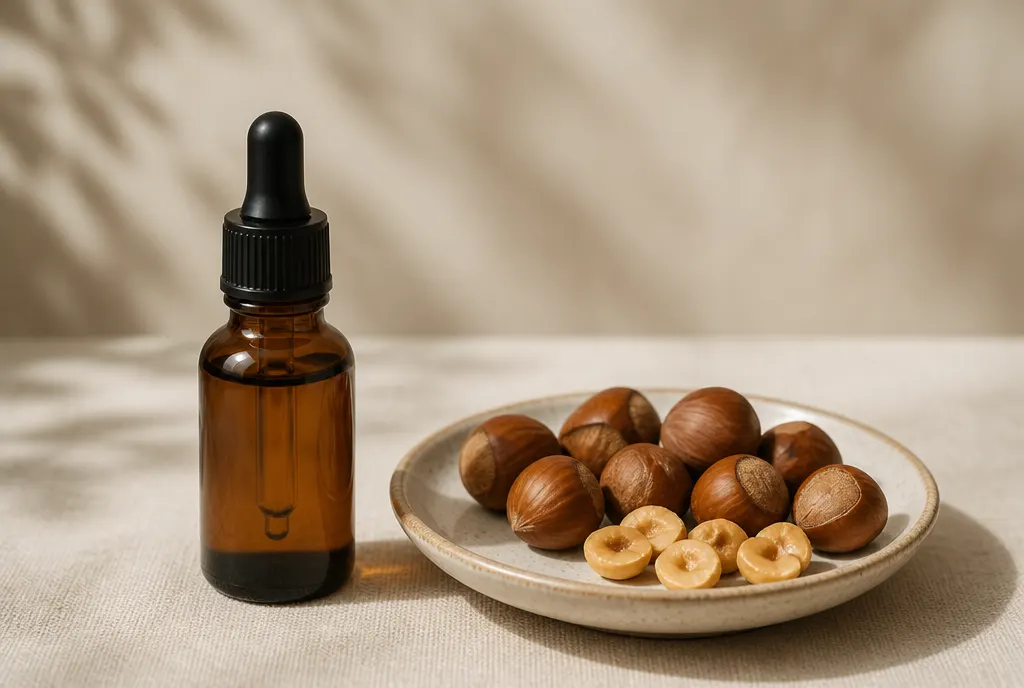
Search for hazelnut flavouring in the UK and you land in the baking aisle and the coffee shop. Cake flavourings, coffee syrups and chocolate bars fill the first page, and nothing on it is made for an e-liquid. Both kinds of bottle can look alike, a small dropper and a promise of roasted hazelnut. They are not made, dosed or meant for the same thing. Before choosing a hazelnut for a DIY e-liquid, it pays to know which bottle you are holding.
Which hazelnut flavouring works in an e-liquid?
For an e-liquid you need a hazelnut flavouring sold as a concentrate for vaping, whose ingredients stop at flavourings and propylene glycol (PG). The hazelnut concentrates from A&L and Aromea, both made in France, are built that way. A baking flavouring, even one labelled “concentrated”, is formulated for food, uses other carriers and says nothing about e-liquid. It is not a stand-in for a DIY concentrate.
Two products that share a name
The mix-up comes from the word “flavouring”, used in both worlds. The product pages still show two opposite approaches, starting with the ingredients and even more so with the doses.
What goes into a baking flavouring
Take two roasted hazelnut flavourings that rank well in search results. The first, from Sosa, is a water-soluble natural flavouring whose page lists a flavouring preparation, glyceryl triacetate, invert sugar syrup and glycerine. It is meant for creams, ganaches, ice cream and sauces, and even for very fatty preparations.
The second, a water-soluble flavouring from Selectarôme, states a sugar content of 47 per cent. Its page also notes that its flavouring components are not all of natural origin. Neither page mentions vaping.
What goes into a vape concentrate
DIY concentrates, by contrast, carry a short list. The A&L hazelnut flavouring, in a 10 ml bottle, combines flavourings and propylene glycol. The Aromea version, described as a fresh hazelnut and sold in 10, 30 or 115 ml, contains only flavouring and plant-derived propylene glycol according to its page, with a safety cap.
That difference in carrier matters. Sugar does not vaporise cleanly, it tends to caramelise on a coil and gunk it up, which no vaper is after.
Doses that have nothing in common
The clearest gap is in the recommended doses. Put them in the same unit and the distance between the two families becomes obvious.
The Sosa page gives 0.2 g per kilo of preparation, or 0.02 per cent. Selectarôme gives a range of 0.1 to 1 per cent, with 0.5 per cent as an average. On the vaping side, A&L recommends starting at 5 per cent in a 50/50 base, and Aromea uses the same 5 per cent for that ratio.
The maths is plain. At 5 per cent, a DIY concentrate is dosed ten times higher than the Selectarôme average and two hundred and fifty times higher than the Sosa guideline. A baking flavouring poured at a vape concentrate’s percentage would give a saturated mix, along with the sugar and carriers listed above. For the sums on a given bottle, our guide to flavour concentrate percentage sets out the method.
Fresh, nutty or roasted, reading the profile
Once you have the right type of bottle, the hazelnut itself still has to be chosen. Product pages use three words that do not mean the same thing.
Fresh hazelnut
This is how Aromea describes its concentrate. The term usually points to a raw hazelnut, milkier and more discreet, which sits well on a creamy base without taking over.
Hazelnut as a dried nut
In an answer published under its product page, A&L says its flavouring recalls the hazelnut as a dried nut, not a roasted one. It stays in nut territory, neither toasted nor sweet, and clear enough to serve as the base of a blend.
Roasted hazelnut
This is the profile of the two baking flavourings mentioned above, with stronger toasted notes. In DIY, a concentrate sold as roasted pulls the mix towards coffee or praline, so it needs a partner that can stand up to that intensity.
Pairing hazelnut flavouring in DIY
Used on its own, as a single flavour, hazelnut mostly gives a background, and it finds its role in a blend, as our comparison of single flavour or one shot explains.
Pairings that extend it
The classic pairings stay in the dessert family. Coffee and roasted hazelnut meet on their toasted notes, vanilla and caramel soften a dry hazelnut, and chocolate leans towards praline. A light, golden tobacco also takes a touch of hazelnut well.
Pairings that muddy it
Tart fruit and cooling notes (mint, eucalyptus) tend to mask hazelnut, or create a contrast that reads poorly. A first test is best kept with hazelnut as the lead note, adding a single partner per test bottle.
Steeping and storing hazelnut flavouring
The product pages disagree on resting time. Aromea gives 2 days in a 50/50 base and 3 days in 100 per cent VG. At A&L, the technical sheet says one week while the description mentions 3 to 5 days. Tasting at several stages beats judging on day one, as our guide to steeping e-liquid explains.
One calculation deserves attention. Because the concentrate is carried in PG, 5 per cent of hazelnut flavouring in a 50/50 base gives a final mix close to 52.5 per cent PG and 47.5 per cent VG. In the UK, nicotine shots and nicotine bases are capped at 20 mg/ml and sold in bottles of no more than 10 ml.
FAQ
These answers cover the practical questions that come up when choosing and mixing a bottle.
Is a “natural” food flavouring better suited to vaping?
No. “Natural” describes where the flavouring components come from, not whether they are fit to be vaporised. The carrier and the use intended by the maker matter more.
How many drops make 5 per cent of 10 ml?
5 per cent of 10 ml is 0.5 ml of concentrate. The number of drops depends on the dropper, which is why a graduated syringe helps with small volumes.
Can a hazelnut concentrate be vaped neat?
No. It is always diluted in a PG/VG base, with or without nicotine, at the percentage its maker recommends.
Does the base ratio change the dose?
Yes. Aromea raises its recommended share as the glycerine content goes up, from 3 per cent in 70/30 to 10 per cent in 100 per cent VG. Glycerine is thicker and dulls the perception of flavour.
Where should an opened concentrate be stored?
Capped, away from light and heat, somewhere safe and out of reach. Writing the opening date on the label helps you track how it changes.
Choosing a hazelnut flavouring for DIY
A hazelnut flavouring for e-liquid shows itself through a short ingredient list and a dose expressed as a percentage of a PG/VG base. Baking bottles are dosed in grams per kilo or in fractions of a per cent, and carry sugar or other carriers designed for food.
Once the right bottle is chosen, the profile does the rest, fresh, nutty or roasted. That habit of reading the label applies to every dessert flavour on the shelf, and it often saves a first test bottle from going to waste.
Editorial content for adult readers only. Nicotine is a highly addictive substance, and nicotine vaping products are not for sale to anyone under 18 in the UK. This article is not a buying recommendation.